Sunday, November 6, 2011

Putting the beds to bed

This weekend I have spent a little time putting some of the garden squares to bed for the winter. They have produced nicely this year, but I want to ensure that the soil is nice and fertile when spring comes and I plant them again.  First I pulled all the plants and cut the vines off the trellis; more stuff for the compost pile! Then I added a wheelbarrow full of chopped leaves and a wheelbarrow full of manure (which amounts to about an inch of manure over a 4x4 square).


The leaves I chopped with the bagging attachment on our leaf blower, however I think the lawnmower attachment would chop them finer and may use it for the next batch. I'll need a bunch for the strawberries too. For the organic gardener, a friend with manure producing animals is a gold mine. We have a friend (Cynthia) who has horses and is just as happy as can be to let me run off with a truck load of manure, much of it already composted. I just put it straight on the beds with the leaves to compost over the winter, since it will be at least four months before I plant-plenty of time for it to break down. I would use chicken manure the same way, and may have my own little poo producers next spring, but unless it is going to sit for a while, compost the manure first or it might burn the plants. Rabbit manure is so mild that it can be put straight on the bed, plants or no plants.
After putting the leaves and manure on the garden I used my garden claw to mix them in.  In the first bed I put the manure out first, then the leaves, and since the leaves were still pretty big, they mostly got clogged up in the claw; the manure over the leaves mixed much better. I'll turn the beds another couple times in the next few weeks to mix things up better. Once I get some lime I will add some of that too since I haven't used it in a few years and my soil tends to be a bit acidic, and oak leaves, which I used, are high in acid. Great for blueberries, not so much for vegetables. I'm also going to have a soil test done for various areas of the yard/garden so I can spot any deficiencies before I plant.Our Agricultural Extension Agency does this for free. I also have a home test kit, but I like the professional analysis too.

So there you are, one bed, put to bed for the winter!


By the way, one of the by products of cleaning up the beds is harvesting the turnips; we are having turnip greens and boiled turnips with dinner tonight. Everything is better with bacon, right?


Friday, November 4, 2011

It's been busy down on the farm

I just realized the other day that I hadn't posted in a month, and a lot has happened, which is why I haven't been writing; I've been too busy doing! I thought that farmers took in their harvest in the fall and then spent the rest of the fall and winter sharpening tools and looking at seed catalogs-not so! I have always been a gardener who stopped gardening towards the end of August, but because I have a lot of expansion plans between now and spring, I have kept going, and still have more to do. However, I'll give a quick update on the projects and write more detail later.

One of the things we have done is to plant fall strawberries. I am the impatient type, and I have a real problem planting strawberries in the spring and not getting any berries until the next spring. I kept thinking about the strawberry farmers I know who plant a new crop each year, and they plant in the fall, so after much searching I found a place that sold fall strawberry plants and ordered twenty five. I have two varieties, Sweet Charlie and Chandler, both of which are supposed to do well in our area.This is what they looked like after planting:


I also planted a fall garden; broccoli, cabbage, turnips, radishes, carrots, lettuce, collards, spinach and chard. The collards have been eaten by some four legged critter, the broccoli and cabbage were also munched on, but survived and may yet produce something. Here are some of the pictures of the things we have been able to eat:


Don't get too excited about the size of the carrots, note my thumb beside them, they are pretty small, but they are delicious at that size. We also have turnips, but I haven't taken any pictures. I also have been making some things with our herbs and have tried my hand at hot sauce.

Another project intended to extend our growing season is a cold frame. I have always wanted to build one but have lacked motivation. I'll provide a blow by blow description later, but basically I built a box and put an old window on top of it to create my own little "greenhouse" I have planted lettuce, spinach, radishes, and onions in it, and I may make another one in the garden proper with the other window later. It's a little rough, but I did make it myself!


So, until I can write in more detail about the other stuff going on here that's it! Another busy day tomorrow, but I'm really loving getting more out of our real estate than a yard to mow.

Thursday, September 29, 2011

Sunflowers

The latest preservation project on the farm is roasting sunflower seeds. I love growing sunflowers, they are huge, beautiful, cheerful flowers that require very little from me besides decent soil and a little water when it is dry.
I planted one Mammoth  sunflower seed in a one foot by one foot square of one of my square foot gardens. It grew to be taller than me, not a great feat since I'm only 5'4", but still, in a few months this plant grew from a tiny seed to a huge plant! Of course I didn't take a picture of it when it was beautiful and yellow, but I did take one after we cut it off the stem and brought it in to roast.


Isn't the spiral pattern lovely? For those math folks out there, the rows are sequences of Fibonacci numbers which I won't try to explain, but it makes for the most efficient packing of the seeds into the seed head. The way God does things is pretty amazing, beauty and efficiency all in one package.

After we cut the head, Dave did the grunt work of rubbing the florets off the seeds, which is a somewhat tedious job, because not only did he have to rub off the florets, but he also had to remove the part of the plant that held the seeds in place so we could get down to just the seeds. Next year we may try doing this part outside in front of an electric fan, tossing the stuff in the air to separate the lighter stuff from the heavy seeds. We really like to eat sunflower seeds, so we will plant more than just one next year.

I always wondered how the sunflower seeds in the shell we bought had such a lovely salt coating, but no salt crystals, a few minutes on the internet, and I discovered their secret: soak the seeds in salt water overnight. Who knew? I'm glad we soaked them, the water was a little dirty looking, so besides adding that lovely saltiness, they got cleaner! Next, a trip to the oven on the cookie sheet.

 That is all the seeds from just one head on an average size cookie sheet. We roasted them about forty minutes at 300*F, until they started to brown.


Voila! the finished product. We of course had to try them out immediately and found that many of our little shells had no seed. Bummer. The ones we found with kernels were wonderful, but they were too few. I researched the situation a little and I think that the problem is lack of sufficient pollination. The seed head is actually not a flower, but a head that holds hundreds of little florets, each one needing to be pollinated, each one having a little seed under the floret that doesn't develop the fruit (kernel) if it isn't pollinated by our busy helpers, the bees.  Sunflowers are self pollinating, so they don't need more than one plant to fruit, but with most fruits, the more the merrier! Also, more flowers attract more bees. That fits in nicely with our plan to plant more sunflowers next year. If we clear enough area and have the space we may grow some of the black oil sunflowers so we can have some for the birds. For now, I guess we may as well enjoy as much of the fruits, or seeds of our labor as possible.


Saturday, September 24, 2011

Can we talk..........compost?

The lifeblood of any good gardening situation is the soil. We have been blessed with abundant, fertile soil in which most things grow well with little intervention from us; just plant it and it will grow. This summer we had to do a bit more watering than usual, and I actually kept things mostly weeded. However, since I prefer to not add chemicals to my food, I use compost and some natural fertilizer to give the heavy feeders a little boost in their growth.

I have been composting in one form or another for over a decade, sometimes efficiently, sometimes...not so much. Once you start composting, you will never see a pile of leaves or vegetable scraps the same way, I have been know to ask my friends for their bags of grass clippings (thanks David), apple peels, Halloween pumpkins, watermelon rinds and so on. I don't ask for leaves because we have several oak trees that keep me well supplied.

One of our newer projects is a new compost bin. I had made one from some cinder blocks we had sitting around, but it only had one bin, was a little small and in a bad location. So we took some pallets and built a new two bin model. I love the pallets, even though I know that they will deteriorate in a few years, but they are free, abundant and perfectly designed for a compost bin.
 We lucked out because we had a very large pallet and the back wall is all one piece so it is more stable, but two nailed together would work just fine. As you can see we just added three "sides" to the back wall, leaving the front open for adding materials. The pallets are terrific because they have spaces, which creates some airflow, a very desirable thing in compost. With two bins I will have one side (in this picture the left) that has almost finished compost that just needs to cook a little longer, and the other side that I am actively adding materials to. If I find that I have a larger pile I may add a six inch board to the bottom to help keep things from spilling out. I keep a pitchfork by the bin so I can turn the materials easily and also pick up leaves to add to the pile when I add greens.

Which brings us to the question everyone asks: Doesn't it smell and attract rodents? I will say that I have never seen evidence of rat activity, I can't speak for the mice since they are so small, and even though we have possums and racoons, I haven't seen any signs they have bothered things. As far as the smell, if you do it right, it is not a problem, if you don't, it can be. Case in point, I received a lovely bag of leftovers from Renee when she made grape jelly, and in addition to that added the leftover mash from making apple juice. The result was too much nitrogen (greens) and not enough carbon (browns) and I had some flies and a lovely fermentation odor. However, it was easily fixed by turning the pile and adding some more leaves. Balance is the main thing with compost, and it is best to err on the side of caution and add too many leaves; they will still break down, but it will just take longer. Outdoor composting does attract insects, however they are not the kind that will live in your house, so you don't need to worry about them. When you add food scraps always cover them with a layer of leaves and you will have no problem with flies; they don't dig and if they can't just land on the food they leave it alone. I thought about taking a picture of all the critters on the apple/grape mash when I turned it, but thought it might freak folks out.

Last but not least, what do you do with the compost once it is finished? How do you know it is finished? Once you really can't tell what the compost was originally made of and it looks like really rich, dark brown dirt, it is finished. You may still have some big chunks, like sunflower stalks or eggshells, but the majority is dark and crumbly. Take any big pieces and toss them on the still cooking pile and you have some nice, beautiful compost, ready to use. One of my favorite uses, since I don't have lots of compost at a time is to use it like a mulch, especially for new plantings like broccoli or tomatoes, because it suppresses weeds and feeds my new plant! Of course I never am patient enough to let my compost finish completely and it doesn't get as hot as a pile with manure so the seeds aren't killed. I usually have to pull up a few cantaloupe plants or watermelons after a week or so. Also, if you have lots of compost, it is great to just turn it into your soil to improve either the nutrients or the amount of organic material. With clay soil the organic material is the more important feature, because without the leaves and "stuff" it just bakes in the sun and doesn't retain water very well.
Well kids, there it is, compost 101, a very simplified version of a fairly simple, yet important to the gardener, topic.  

Tuesday, August 30, 2011

Sun dried apples

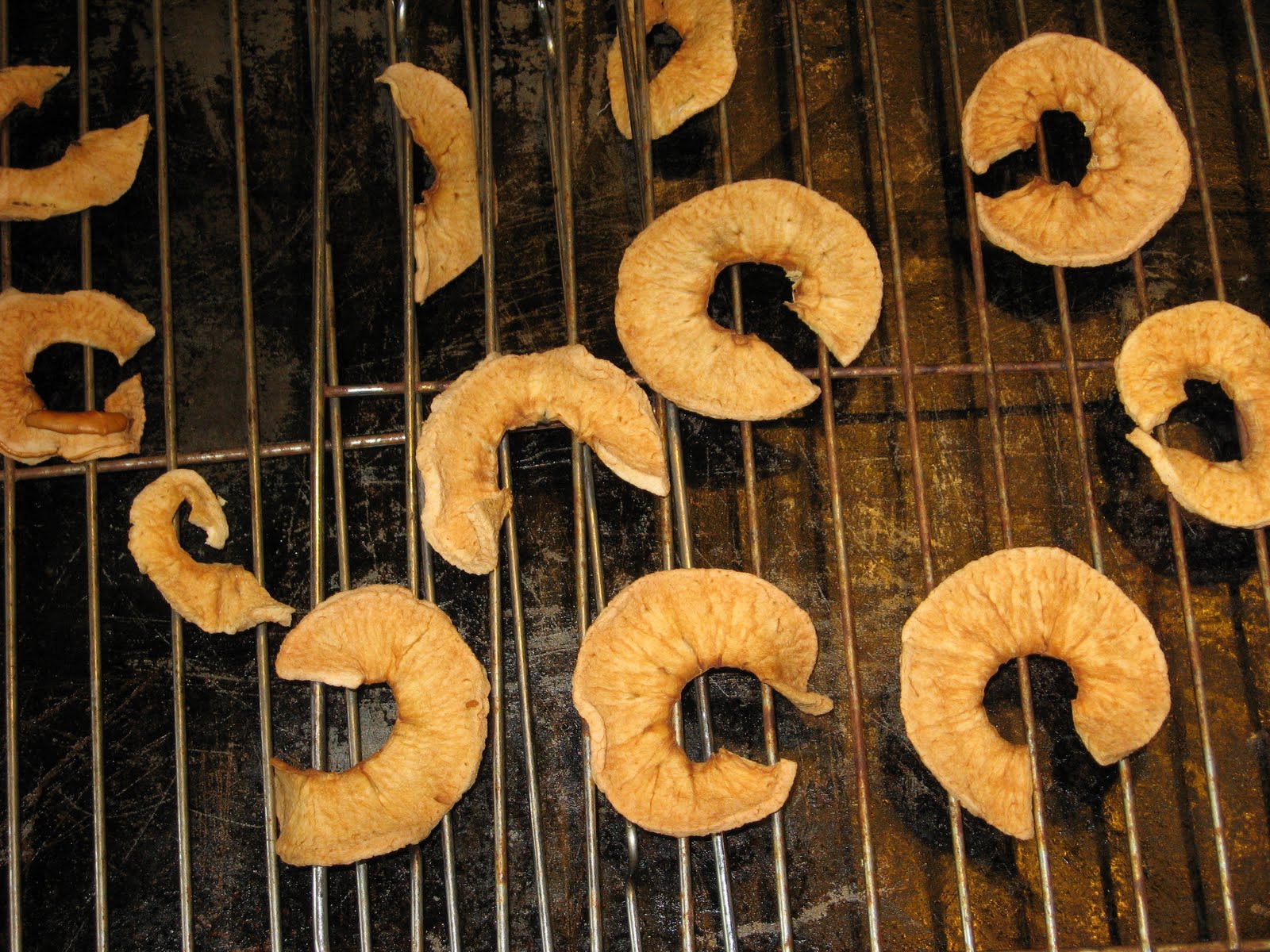
We went and picked apples with friends a few weeks ago and I am still trying to figure out what to do with the bushel that I picked. I know, a bushel? Without a plan? But they were so delicious and the price was right and we drove out in the country to get them and what if I wanted more and didn't have time to go get more? So, I have made two quarts of  apple juice/cider, which lasted about two days, and have given away some, and I feel too lazy to make applesauce yet. I have been wanting to try drying fruit and thought this would be a great opportunity, but little did I know it would be such a pain to find the stuff to do it! One would think a piece of screen and something to cover it with to keep the flies off would work, but of course the more I read about food drying, the more difficult it appeared! Regular screen isn't good, it has toxins in it, food grade screen is required and is difficult to find, even online. Cheesecloth is good to cover the fruit, but more difficult to find locally than I anticipated. So I ended up using my oven rack to lay the apples on, Renee gave me a lead on a local source for the cheesecloth and I ended up with this:
That is two apples on half of the cheesecloth, I covered them with the other half and set them out in the sun for about four hours. This is what they looked like when I brought them in:
Yesterday, I set them out before I went to work, and of course, it is the only day it has rained in ages, and it poured for an hour before I got home, so I had partially rehydrated apples. I put them in the oven for about half an hour at 170* to dry them out a little so they didn't mold. I hoped that one more day in the sun-without rain- might finish them off. I changed things up a little, I put the apples on cake racks on a black cookie sheet with the cheesecloth over them. That worked like a charm!
At this point they are completely dry, just like you would buy in the store. I didn't add any lemon juice because we don't care if they are brown. If it looks like there are fewer apples rather than just smaller apples, you would be right, we kept sampling at each stage. I need to get more cheesecloth or a piece of muslin so I can do more at a time on the oven rack. We found that laying them directly on the cake rack caused them to pick up a bit of a metallic taste, so I won't do that again. Other than that, I think the experiment went well. I'm going to try again tomorrow!

Sunday, August 28, 2011

Let the Hurricane winds blow!

Well, hurricane Irene left us high and dry! While the eastern half of the state was getting several inches of much needed rain, all we received was a lot of wind and a cloudy day. However, the cloudiness was exactly what I needed for my task for the day, planting some fall seedlings. I took off on a reconnaissance  mission at Southern States and I found that they had many of the things that I will be needing in the future, including chicken supplies and seed for clover, along with several other cover crops. They also have several varieties of chicks in late February, so we have a local supplier for chickens at that time. I like the idea of being able to pick several different types all at the same time so they grow up together; I know that at some time I'll have to introduce new chickens to the flock, but I'd like to start off easy. They also had some broccoli and cabbage plants; I bought four cabbages that I hope to turn into some lovely cabbage rolls in November and eight broccoli, because I found out in the spring that four are not enough for us! We really like broccoli. I had to both put water in the planting hole before planting and water again after planting since it is so very dry. Then I did the ultimate twofer; I mulched the plants with a layer of compost, giving the plants both nutrition and moisture conservation. I would post a picture of the plantings, but it looks just like the one I took in the spring, so I'll show you the little friend we found in the frame I was planting:
Our toad friend

 We always have toads in the garden, and I love having them there. They are little insect destroyers. I try to do what I can to attract them because we don't use insecticides and I love the free insect service. We really don't have a big problem with pests of the six legged variety, just the four legged variety. As you can see in the next picture, I have wire around the back of the tomatoes, and over the bed to keep the deer/bunnies/groundhogs out of my food.
Vertical Tomatoes

We are growing four tomatoes vertically in four square feet of soil, whereas if we were growing them in traditional cages or staked they would take sixteen square feet, or the whole square. In retrospect, I need to use either wire or stouter string for the trellis because this one is sagging with the weight of the tomatoes. See the almost ripe Cherokee Purple? The deer got all of the last ones because I let my guard down and left the wire off just before several tomatoes ripened.  In front of them I have recently planted a mix of radishes, turnips, beets, onions and spinach. I haven't seen any spinach yet, it think it might be too hot for the seed to germinate, so maybe it will turn up later when it cools down.
Seedlings


This seedling bed previously had onions, turnips, lettuce and spinach in it. I'm trying to get the most of the long growing season by planting succession crops this year, of course with the drought I'm having to water much more than I want to, I just hope that we will get some rain soon.

Friday, August 26, 2011

Not quite a farm-yet

Several years ago when Dave's dad visited us he christened our little plot the "Farm in the City". We are in the city limits, and it isn't much of a farm yet, but it is a nice size piece of real estate for a city lot, a little over an acre. The neighborhood kind of has a country feel, or used to when we bought the house over ten years ago. There has been some development etc that has caused it to loose some of that feel, but the houses to our right and left and their lots have stayed much the same; mature oaks and hickorys, some grass, and the ever present kudzu.

We have talked off and on about adding to the small garden, hickory trees, two dogs and a cat that we have already, but the only real, permanent things we have done is to plant some blueberry bushes and a grape vine. Granted, they produce, but we could do so much more. And so it begins, our quest to have a real farm in the city. As of now I am ordering apple trees and blackberry canes and preparing the soil in various parts of  the lot for food next spring. Also, for the first time I am going to plant fall crops, I hope to get some broccoli and cabbage tomorrow. Oh yes, and we are going to get chickens. I am currently planning a coop that we hope to build completely, with the possible exception of the hardware, from salvaged and scrap material. So if you have some extra hinges..........

Spring square foot garden-broccoli, lettuce, cabbage
I thought that writing about what is going on might be interesting to someone else who is on the same quest; a bit of independence and good use of our God given resources. OK, so I thought at least my sister and my mom would read what I have to say. And maybe my brother. And if I'm really lucky, my kids, who are probably going to try to ignore the whole thing. So, off to the next thing, hopefully I'll not lose steam and stop writing, I think it is going to be an interesting year.